Peer Review Process
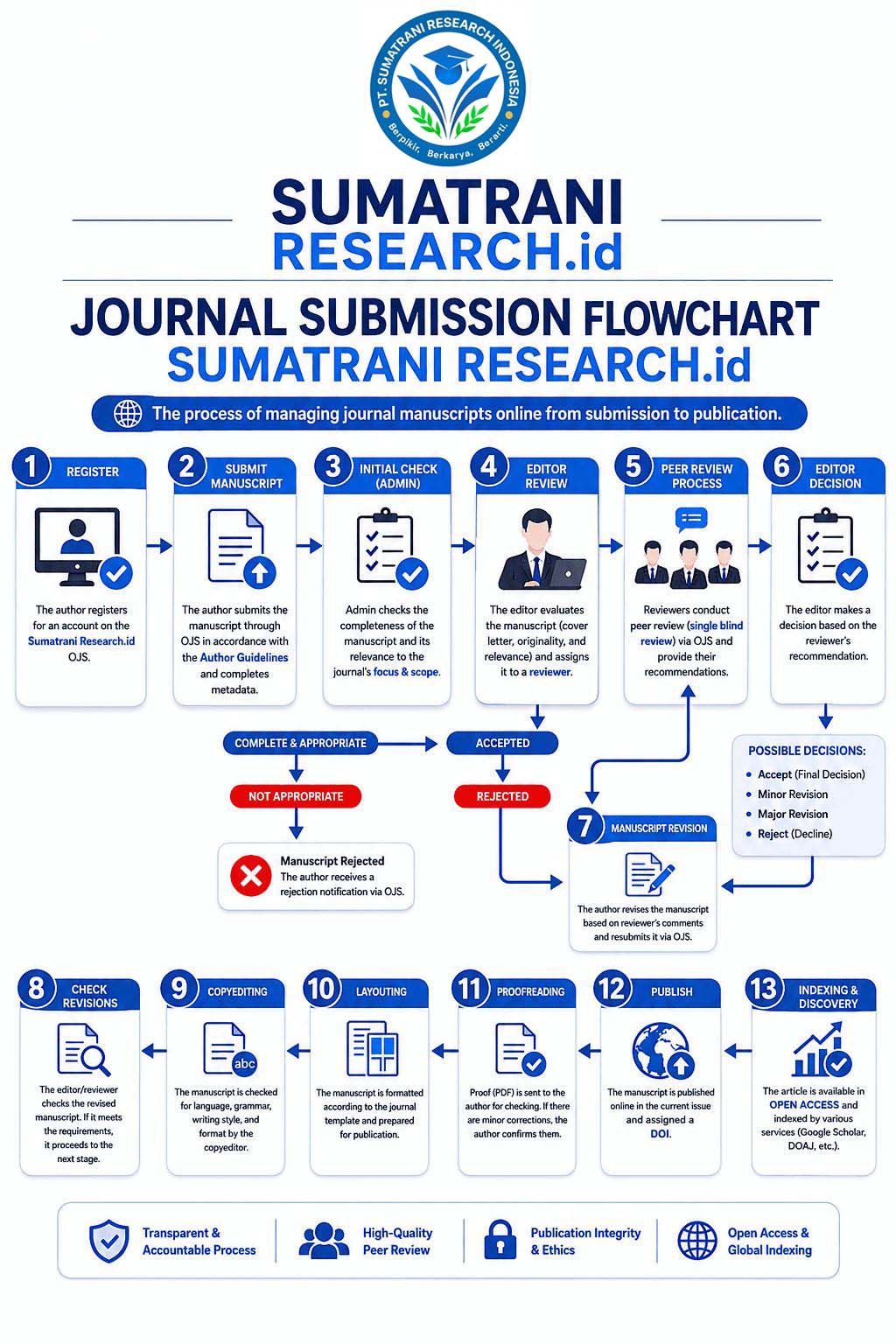
1) Submission & Initial Editorial Screening
-
Technical check. The Editorial Office verifies completeness (metadata, ethics statements, data availability), manuscript fits the journal’s scope, and adheres to author guidelines.
-
Research integrity screening. Submissions undergo similarity checking (e.g., iThenticate) and basic research-integrity checks. Suspected misconduct is handled following COPE guidance and flowcharts. publicationethics.org+1
-
Desk decision. The Editor-in-Chief (EiC) or a designated Handling Editor may desk reject submissions that are out of scope, methodologically unsound, or evidently below threshold; otherwise the manuscript proceeds to external review.
2) Assignment to Handling Editor
An expert Handling Editor is assigned based on subject area and methods. The editor oversees reviewer selection, the review process, and the editorial decision, ensuring fair and timely handling consistent with best-practice guidelines. publicationethics.org
3) Reviewer Selection & Invitation
-
Number & expertise. Typically 2–3 independent reviewers with relevant expertise are invited. Reviewers must be free of conflicts of interest (COIs) with the authors or their institutions.
-
Eligibility & ethics. Reviewers are asked to follow the COPE Ethical Guidelines for Peer Reviewers (confidentiality, objectivity, timeliness, declaration of COIs). publicationethics.org+1
-
Diversity & balance. JEMDE seeks a balanced reviewer pool across geography, gender, and methodology where feasible.
4) Conduct of the Review
-
Confidentiality. Manuscripts and reviews are confidential; material may not be shared or used for personal research. members.publicationethics.org
-
Evaluation criteria. Reviewers assess: (a) originality and contribution; (b) theoretical framing and literature integration; (c) methodological rigor and transparency; (d) data & analysis validity; (e) clarity of exposition; (f) implications for economics, management, development, and/or education; and (g) research ethics and reproducibility (where applicable).
-
Structured feedback. Reviews should provide a concise summary, major comments, minor comments, and a recommendation, aligning with common best-practice formats for actionable peer-review reports. MIT Communication Lab
-
Use of Generative AI by reviewers. Reviewers must not upload confidential manuscripts to public AI tools. Any assistive use of AI (e.g., grammar checking) must preserve confidentiality and reviewers remain fully responsible for the content; the journal encourages transparent disclosure to the editor, reflecting evolving expectations around GenAI use in peer-review workflows. Elsevier Scopus Blog
5) Editorial Decisions
After synthesizing reviewer reports and their own assessment, editors issue one of the following decisions:
-
Accept (as is or with minor editorial edits);
-
Minor Revision (targeted changes; typically one round of checks by the editor);
-
Major Revision (substantial changes; usually re-review by original reviewers);
-
Reject (not suitable for JEMDE or below threshold).
Editors may invite resubmission where appropriate. Decision letters summarize the rationale and include anonymized key points from reviews.
6) Revisions
Authors submit a point-by-point response addressing each comment and a tracked-changes manuscript. Revised versions may be re-sent to reviewers at the editor’s discretion. To maintain efficiency, the number of major-revision cycles is typically limited.
7) Appeals & Complaints
Authors may appeal a decision by writing to the EiC with substantiated reasons (e.g., a factual error). Appeals are considered by the EiC or a delegate not involved in the original decision and may involve additional reviewers. Complaints or ethical concerns (e.g., undeclared COIs, suspected plagiarism) are handled in accordance with COPE guidance. publicationethics.org
8) Conflicts of Interest (COIs)
All editors and reviewers must disclose any potential COIs (financial, collaborative, institutional, or personal) and recuse themselves where appropriate. COI management follows recognized ethical frameworks for editorial practice. UAB Barcelona
9) Transparency, Timelines & Communication
-
Transparency. The journal publicly states its peer-review model and procedures on its website, including any exceptions for specific content types; it does not promise acceptance or unrealistically short review times. googleapis.com
-
Indicative timelines. Typical stages (subject to variation by submission volume and reviewer availability):
-
Editor assignment & preliminary checks: ~1–2 weeks;
-
Reviewer invitation & acceptance: ~1 week;
-
Review completion: ~3–5 weeks;
-
First decision after reviews: ~1–2 weeks.
Where delays occur, authors are informed and may withdraw if they prefer. Jurnal UII
-
10) Research Integrity, Ethics & Misconduct Handling
JEMDE adheres to the Principles of Transparency and Best Practice in Scholarly Publishing and COPE guidance on handling allegations (plagiarism, duplicate submission, citation manipulation, data fabrication/falsification). Corrections, expressions of concern, or retractions follow established procedures. publicationethics.org+1
11) Data, Materials & Reproducibility
Where relevant to the field and methodology, authors are encouraged to share data, code, and materials or to provide a clear data-availability statement (and justification when data cannot be shared). Editors and reviewers may request additional detail sufficient to evaluate reproducibility. These expectations align with widely recognized best-practice frameworks referenced by Scopus during evaluation. publicationethics.org+1
12) Generative AI — Author & Reviewer Use
-
Authors. Any use of AI or AI-assisted tools in the writing or analysis must be disclosed in the manuscript (e.g., in the Methods or Acknowledgments) and authors remain responsible for the accuracy and integrity of all content.
-
Reviewers/Editors. Do not upload confidential content to public AI systems; any permissible assistive use must preserve confidentiality and be disclosed to the editor upon request. Scopus has encouraged journals to clearly disclose GenAI policies in the interests of transparency. Elsevier Scopus Blog
13) Non–Peer-Reviewed Content
Article types that do not undergo external peer review (e.g., editorials, book reviews) are clearly labeled on the journal website and on the article itself. publicationethics.org
14) Post-Acceptance Checks & Publication
Accepted papers undergo editorial quality checks (metadata accuracy, reference completeness, ethical statements, COI disclosures), copyediting, and proofing prior to publication.
15) Policy Governance
This policy is reviewed periodically and updated as needed to reflect advances in best practice, ethical guidance, and indexing requirements relevant to Scopus evaluation (e.g., transparent peer-review description on the journal website and robust ethics/ malpractice statements).