Submissions

Login or Register to make a submission.

Submission Preparation Checklist

As part of the submission process, authors are required to check off their submission's compliance with all of the following items, and submissions may be returned to authors that do not adhere to these guidelines.
  • The submission has not been previously published, nor is it before another journal for consideration (or an explanation has been provided in Comments to the Editor).
  • The submission file is in OpenOffice, Microsoft Word, or RTF document file format.
  • Where available, URLs for the references have been provided.
  • The text is single-spaced; uses a 12-point font; employs italics, rather than underlining (except with URL addresses); and all illustrations, figures, and tables are placed within the text at the appropriate points, rather than at the end.
  • The text adheres to the stylistic and bibliographic requirements outlined in the Author Guidelines.

Author Guidelines

SCIENTIFIC ARTICLE WRITING INSTRUCTIONS

Journal of Economics, Management, Development, and Education (JEMDE)

General

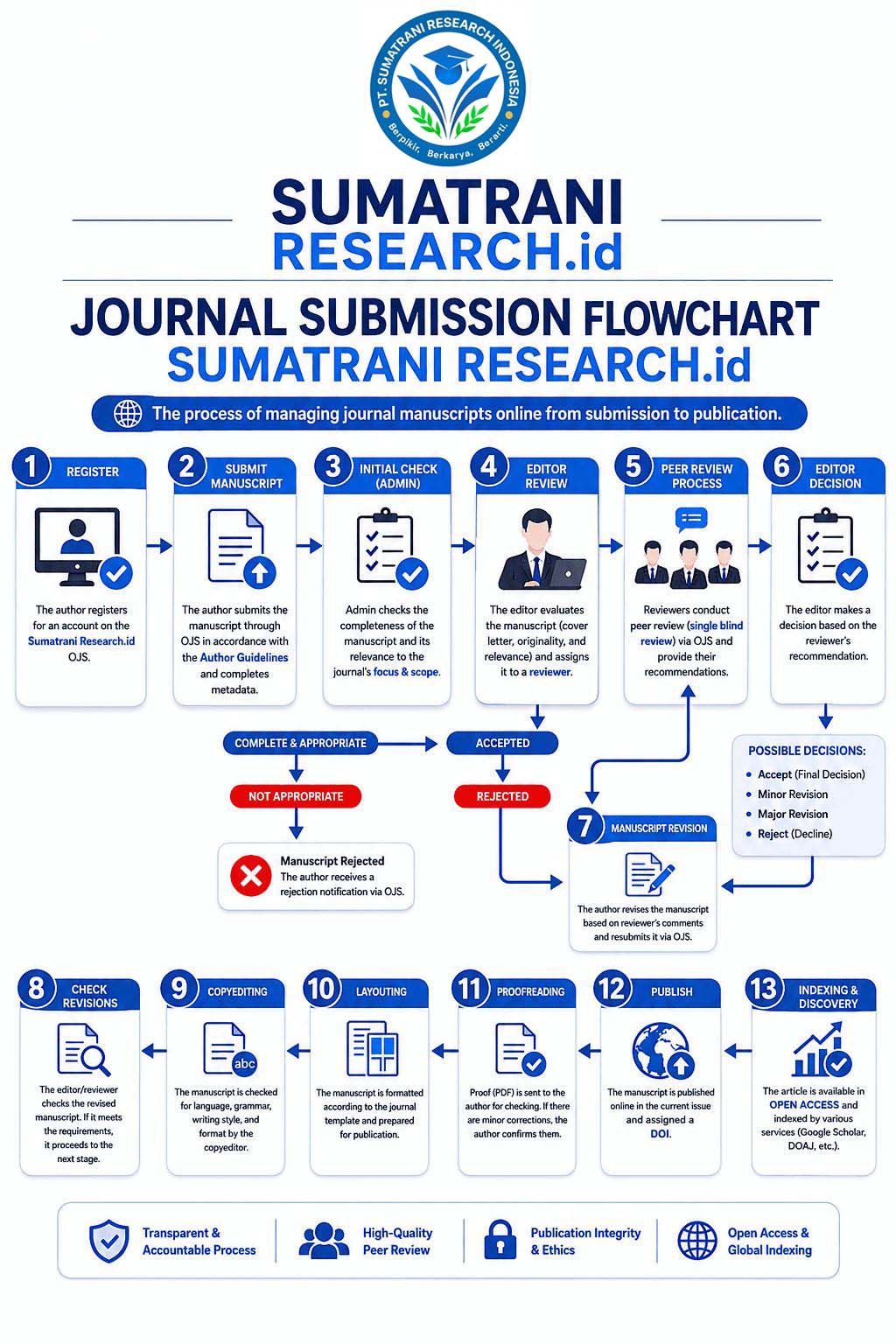
All manuscripts must be submitted to the Journal of Economics, Management, Development, and Education (JEMDE) Editorial Office via Online Submission, where the author registers as an Author and/or is offered as a Reviewer online. If the author experiences problems with online submissions, please contact the Editorial Office via email or WhatsApp Support. Articles must contain research results and scientific study results that raise actual and scientific ideas in the fields of Economics, Management, Development, and Education.

Articles submitted for publication must be original works that have never been published in other scientific journals or proceedings. Articles may be written in Indonesian or English, using good and correct written language rules. Articles submitted should follow the journal template which can be downloaded from the journal website.

Manuscript Format

The article must be written in manuscript form using MS Word with A4 page size (210 × 297 mm) with the following margins:

  • Left margin: 25 cm
  • Top margin: 30 cm
  • Right margin: 20 cm
  • Bottom margin: 20 cm

The article must be written in a single-column format with a simple text layout. It is recommended to use only the writing facilities provided in MS Word (bold, italics, subtitles, superscript, equations, etc.) and not to use other facilities that are not available in MS Word (embedded graphic design, embedded symbols, embedded equations, etc.). All text sections in the manuscript must be written using Times New Roman 12 pt font and 1.15 spacing.

Special Instructions

The manuscript begins with the title, author’s name, author’s address, abstract, and keywords, followed by the content section consisting of:

  1. Introduction
  2. Research Methods (Model Development)
  3. Results and Discussion
  4. Conclusions
  5. Acknowledgments
  6. List of Notations (if any)
  7. References
  8. Appendices (Figures and Tables)

In writing the manuscript, figures and tables are not presented together with the text in the content section, but are placed in the Appendix section, each equipped with a serial number and title.

  • The figure number and figure title are written below the figure.
  • The table number and table title are written above the table.

Please ensure that the quality and size of the figures are large enough to produce good print quality (one page for one figure is recommended).

Please do not use a frame:

1. Title, Author Name, Author Address, and Corresponding Author

  • The title of the article must be written concisely but informatively. It is advisable not to use abbreviations and formulas that are not widely known.
  • The names of all authors are written under the title in full, without academic titles. At the end of each author’s name, a superscript letter is provided to identify the author’s address. The corresponding author must also be identified.
  • Author addresses are written below all author names, beginning with the superscript letter corresponding to each author.
  • The correspondence address is written in the footnote on the page containing the author’s name. The address must contain a complete and clear postal address, including e-mail, telephone, and facsimile (if available).
  •  

2. Abstract and Keywords

  • The abstract must be written concisely and contain the aims/objectives, results, and conclusions to be highlighted. The abstract length should be about 150–200 words. Abstracts are recommended not to contain abbreviations or formulas that are not widely known.
  • Immediately below the abstract text, write six (6) keywords, separated by commas (,).
  • Abstract and keywords must be written in two languages, namely Indonesian and English.

3. Introduction

The introduction section must present:

  • The background of the research/writing
  • A brief literature review describing the state of the art
  • The objectives of the research/writing

4. Research Methods (Model Development)

This section describes the materials used in the research. The research methods must be presented in sufficient detail to ensure that the results are reproducible.

If the submitted manuscript is a model development, the author must provide a description of the proposed model and how the model is evaluated/used.

5. Results and Discussion

This section presents the research results (or model development results) systematically and constructively, accompanied by a comprehensive discussion that supports the research objectives and strengthens the conclusions.

Although results may be presented in the form of tables or figures, these tables and figures must not be inserted in the text, but must be attached in the appendix. In the text, it is sufficient to mention the table or figure number and/or title.

6. Conclusions

This section briefly presents the main conclusions derived from the research results.

7. Notation List

The notation list must be written in alphabetical order. Latin letter notation (including Greek letters) is written before the notation of alphabet letters.

8. References

  • References in the text

The source of a quotation or excerpt in the text must be written using the following rules:

  1. Single author: author’s last name (without initials unless confusion occurs) and year of publication
  2. Two authors: both authors’ last names and year of publication
  3. Three or more authors: the last name of the first author followed by et al. and year of publication

References may be written directly in the text or in parentheses ( ). If there are several sources, they should be arranged alphabetically and then by year of publication.

Example:
“... as revealed in previous research (Allan, 1996a, 1996b, 1999; Allan and Jones, 1995). Kramer et al. (2000) recently stated that ...”

  • References in the Bibliography

The bibliography must be arranged alphabetically by the author’s last name and year of publication. If there are several references by the same author in different years, an index letter “a”, “b”, “c”, etc. must be added after the year.

Examples:

  1. Journal/Proceedings:
    Capek, P., Hejtmanek, V., Solcova, O., Klusacek, K. and Schneider, P., 1997. Gas transport in porous media under dynamic conditions, Catalysis Today, 38, 31–38.
  2. Book:
    Strunk Jr., W., White, E.B., 1979. The Elements of Style, third ed. Macmillan, New York.

Book chapter (edited volume):
Mettam, G.R., Adams, L.B., 1999. In: Jones, B.S., Smith, R.Z. (Eds.), Introduction to the Electronic Age. E-Publishing Inc., New York, pp. 10–11.


Articles

Section default policy

Privacy Statement

The names and email addresses entered in this journal site will be used exclusively for the stated purposes of the Journal of Economics, Management, Development, and Education (JEMDE) and will not be made available for any other purpose or to any other party.

All personal data provided by authors, reviewers, and readers will be handled confidentially and securely. The journal only collects information necessary for the editorial and publication process, including manuscript submission, peer review, publication, and communication related to journal activities.

JEMDE is committed to protecting the privacy of all users and ensuring that personal information is processed in accordance with applicable data protection regulations.